

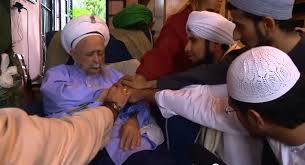
Ahl al Bayt
“Allah wishes to remove all abomination from you,
Ya Ahl al Bayt,
To make you clean and pure”
Said the Lord in His holy Book
About the blessed Household for sure.
Al-Jabir testifies: on the Day of ‘Arafat
Said the blessed Prophet upon him be peace,
“O people I leave behind two things,
Adhere to them and you’ll never be misguided,
The Qur’an and my Ahl al Bayt.”
Abu Zarr says at the gate
Of Qaba, “My Ahl al Bayt is like Noah’s Boat,
Those who entered were saved
And those that remained were destroyed”
Reported in the Sunan of Ahmad.
“O free men, how am I your lord,”
asked Saiyyiduna Mawla ‘Ali?
“You are lord over the Prophet’s kingdom,
Whoever submits to Muhammad
Takes you as his lord.”
By the order of the Prophet
You purified the Qaba,
Smashed all the idols
Standing on his shoulder,
Symbols of tawhid, Ya Ahl al Bayt.
“Hussain is from me and I from Hussain,
I am at war with those who fight them
Allah loves him who loves Hussain,
The leaders of paradise
Al-Hasan and Husain.
“Allah wishes to remove all abomination from you,
Ya Ahl al Bayt,
To make you clean and pure”
Said the Lord in His holy Book
About the blessed Household for sure.
“The seeker must follow a perfect Master able to guide him to the way of Allah, Almighty and Exalted, and to illuminate for him that way until he reaches the State of Annihilation. The seeker must give his oath and his promise to his guide, to learn from him how to leave his bad manners and to lift himself to better conduct in order to reach the Perfect Knowledge of Spirituality.
The meaning of initiation and its conditions have been mentioned in the Holy Qur’an, in the Sunnah of the Prophet and in the life of the Companions.
1. In verse 10 of Surat al-Fath, “Verily those who swear allegiance to thee indeed swear allegiance to Allah. The hand of Allah is over their hands. So whoever breaks his oath, breaks it to his own loss; and whoever fulfills the covenant that he has made with Allah, He will surely give him a great reward.” [48:10]
2. In verse 91 of Surat an-Nahl, “And fulfill the Covenant of Allah when you have made it; and break not your oaths after making them firm, while you have made Allah your surety. Certainly, Allah knows what you do.” [16:91]
3. In verse 34 of Surat al-Isra’, “and fulfill the covenant, for the covenant shall be questioned about.” [17:34]
We see the Qur’an encouraging the people to give their oath and to keep their oath to the Prophet (s), who leads them to the presence of Allah, Almighty and Exalted. That initiation was done in the time of the Prophet (s) and after the time of the Prophet (s).
According to the Sunnah of the Prophet (s), the oath was taken from men, as a group, or as individuals; from women, as a group or as individuals, and even from children. Bukhari and Muslim narrate that ‘Ubada ibn as-Samit said, “The Prophet (s) said, ‘Give me your pledge and oath not to associate anything with Allah, not to steal, not to commit adultery, not to kill your children, not to backbite, not to fall into sin; and who keeps his promise, then his reward is from Allah, Almighty and Exalted.’ And then we gave our pledge to the Prophet (s) and our oath.”
The Prophet (s) used to give initiation (bay’ah) to all people and urged them to take it. Bukhari and Muslim narrated in their books that ‘Abdullah ibn ‘Umar said, “When we pledged to the Prophet (s) to listen and obey, the Prophet (s) used to say, ‘To the limit that you can carry.'”
Initiation of Women
The Prophet (s) gave baya’h to women many many times. It is narrated by Imam Ahmad in the Musnad that Salma bint Qays said, “I came to the Prophet (s) with many people from the Ansar, and we gave him our bay’ah, our pledge that we would not associate anyone with Allah, we would not steal, we would not commit adultery, we would not kill our children, we would not backbite and we would not disobey. We gave him our bay`ah and we went.”
Initiation of Children
The Prophet (s), according to the books of Nisa’i and Tirmidhi gave initiation to Umayymah bint Ruqiyyah. It was narrated by Tabarani that ‘Izza bint Khayyil took initiation from the Prophet (s) when they were not yet seven. It was also narrated by Tabarani in in an authentic hadith that the Prophet (s) gave bay’ah to al-Hasan, al-Hussain, ‘Abdullah ibn ‘Abbas and cAbdullah ibn Jacfar when they were 7 years of age.
The Companions of the Prophet (s) gave bay’ah to the khalifs of the Prophet (s) after his passing. It is narrated through the books of Sirah of the Sahhaba that the Sahaba gave bay’ah to Abu Bakr as-Siddiq, to ‘Umar ibn al-Khattab, to ‘Uthman ibn ‘Affan, to ‘Ali, to Mu’awiya, and to all the khalifs who came later, as they had given it to the Prophet (s).
The Prophet (s) said in a hadith related by Abu Dawud and Ahmad, “Whoever imitates a group of people will be of them.” So the inheritors of the Masters of the Sufi orders, especially the Naqshbandi Sufi Order, inherited the initiation in every century. As it was an obligation in the time of the Prophet, and in the time of the Sahaba and in the time of the Tabi’in and Tabi’ at-Tabi’in, and in the times of the Umayyads, Abbasids, Seljukids, and Ottomans, so it is also an obligation to give our bay’ah to a perfect guide, who guides us to the Way of Allah, Almighty and Exalted. And who is a better guide than the Sufi Masters who are inheritors of the Prophet (s) and inheritors of the Divine Presence?
The scholar Abul Hasan ‘Ali Nadwi wrote in his book Rijal al-Fikr wa-d-Da’wah, page 253, “Abdul Qadir Jilani, the Ghawth of the Sufi Orders, Shaikh Muhiyideen ibn ‘Arabi, and all the Masters of the Naqshbandi Golden Chain, opened the door of initiation as wide as possible, for every individual who has good and true belief, to find something that will be of value to him spiritually, and for everyone to renew his bay’ah with Allah, Almighty and Exalted. These Sufi Masters of the Naqshbandi Golden Chain and all Sufi orders lifted their followers to a station of Truthfulness, to feel the responsibility of their initiation and to renew their faith.”
Thus we see that it is an important factor in every Sufi Order for one to take bay’ah with the shaikh, in order to sanctify oneself and to be lifted up to the Divine Presence. These guides are the revivers in every century, to connect our hearts with the heart of the Prophet (s), who in his turn connects our heart to the Divine Presence. These guides are the beacon of the light of the Prophet (s) and the light of the Divine Presence and they are the true examples for all nations to follow.”
(http://www.naqshbandi.org/topics/taking.htm)
The Hunter and the Hunted
Mathnawi V: 723-760
723 He is so drowned in his own passion (for hunting, that) he is
unaware of his own pursuer and hunter.
If grass is devouring some water and air, an animal’s stomach is
grazing (close) behind.
725 That grass is (both) the eater and the eaten, just as anything
that exists– other than God.
Since He is (described in the verse as) “And He feeds you and is
not fed,”1 God is neither eater or eaten, (like living) flesh and skin.
The eater and the eaten are never safe from some (other) eater,
which is waiting quietly in ambush.
The security of the eaten ones is attractive for bereavement (to
follow). Go (for security) to that Court, for He “is not fed”!
For every mental image, there is some (other) mental image
consuming (it); for (every) thought, there is another thought
grazing on (it).
730 You aren’t able to escape from a mental image, or to sleep so
that you can jump outside of it.
Thoughts are the bees, and that sleep of yours (is) the water (in
which you try to escape); when you wake up, the bees come back.
Many mental “bees” fly in, to draw (you) this way and take (you)
that way.
These mental images are the least of those which devour, and the
Owner of Majesty2 knows (well the power of) the others!
Take care! Escape from the crowd of rough devourers,3 to (refuge
in) Him who said, “I am your Protector.”4
735 Or (flee) to the one who has obtained (from God the power of)
protection, if you are unable to hurry (directly) to that Protector.
Don’t pledge (your) hand (to any), except to the hand of the (sufi)
Elder,5 (for) God has become the “Hand-Holder”6 for his hand.
The (sufi) Elder (is) your (guiding) intellect, (which) has been
made habitually childish from being the neighbor of the ego, which
is within the veil [of selfish passions].
Join (that) perfected intellect to (your weak) intellect, so that
(your) mind may turn back from that harmful nature.
When you put your hand in his hand, then you will jump outside
the grasp of the devourers.
740 (And) your hand will become (part of) the “People of the
Pledge,”7 since “The Hand of God is over their hands.”8
When you have given your hand to the sufi Elder’s hand– the wise
Elder who is knowing and honorable,
Since he is (like) the prophet of his time,9 O disciple, so that the
light of the Prophet becomes visible (in him),
By this you will have been present at Hudaybiya and a fellow
companion to the Companions of the Pledge.10
Then you will have become (like one) of the Ten of Good News,11
(and) you will have become purified like pure gold.
745 (And this is) so that (your) association may become right,
because a man is joined to someone he has made friends with;
He is with him (in) this world and the next– and this is (the
meaning of) the saying of sweet-natured Ahmad,12
(Who) said, “A man is with the one whom he loves,”13 (meaning
that) the heart is not separate from its desired object.
Sit less (often) wherever there is a trap and bait. O you who
suppose others to be weak: go (and) look (carefully) at those who
take others to be weak.
O assumer of the weakness of the weak, know this: (that) there is
also a hand above (your) hand, O young man!
750 You are weak, and (yet) you assume weakness (in others)–
how amazing! You are both the prey and the hunter in pursuit!
Don’t be (like those mentioned in the verse who have) “a barrier14
in front and behind them,” so that you will not see (your) enemy,
and (yet your) enemy (will be) obvious.
The greed of hunting is negligence of being the prey; he (thinks he)
is winning a (sweet-) heart, but he is lacking a heart!
Don’t be less than a bird in seeking, (since even) a sparrow sees
“in front (and) behind.”
(Because) when it comes next to the seed, it turns (its) head and
face forward and behind (at that) moment.
755 Thinking, “I wonder (if) there is a hunter in front or behind
me?– so that I should draw back from this morsel because of fear
of him.”
You should see behind (you in) the stories (in the Qur’an) about the
wrongdoers; you should (also) look in front (of you) at the deaths
of (your) friends and neighbors,
For He brought destruction upon them without (need of) an
instrument, and He is connected to you in every situation.
God punished (them) without (need) of a hand or mace: so know
that God is the Justice-Maker without hands.
The one who would say [in public], “If God exists, where (is
He)?”– he was on the (torture) rack15 confessing, “He
[exists]
!”
760 The one who said, “This (“existence”) is strange and remote,”
was shedding tears and continually calling out: “O (You who are)
Near!”16
(http://www.dar-al-masnavi.org/n-V-0723.html)
–From “The Mathnawî-yé Ma`nawî” [Rhymed Couplets of
Deep Spiritual Meaning] of Jalaluddin Rumi.
Translated from the Persian by Ibrahim Gamard (with
gratitude for R. A. Nicholson’s 1934 British translation)
© Ibrahim Gamard (translation, footnotes, & transliteration)
First published on “Sunlight” (yahoogroups.com), 7/30/99
Notes on the text, with line number:
1. (726) is not fed: part of a verse in the Qur’an (6:14, modified for
metrical purposes): “Say: ‘Shall I take a protector besides God, the
Maker of the heavens and the earth, and He that feeds and is not
fed?”
2. (733) Owner of Majesty [Zu ‘l-jalâl]: one of the “Ninety-Nine
Names of God” in sufism. “And the Face of your Sustaining Lord
will last (for ever): the Owner of Majesty and Honor” (Qur’ân
55:27, 78).
3. (734) rough devourers: “i.e. our vile passions and the sins to which
they impel us.” (Nicholson, Commentary)
4. (734) Protector [HafîZ]: another of the “Ninety-Nine Names of
God”: “Truly, my sustaining Lord is the Protector [HafîZ] over
everything” (Qur’an 11:57; 34:21).
5. (736) Elder [pîr]: means the sufi shaykh, master, guide, spiritual
director
6. (736) hand-holder [dast-gîr]: an idiom meaning one who comes to
aid and protect. Refers to the sufi initiation, or “pledge of
allegiance” [bay`at], in which a spiritual seeker becomes a disciple
by taking the hand of the sufi guide. This ritual is itself based on a
Qur’anic verse about a famous pledge given to the Prophet
Muhammad by his followers at a place called Hudaybiya:
“Certainly, those who swear allegiance to you are swearing
allegiance to God, (and) the Hand of God is over their hands” (Q.
48:10).
7. (740) the People of the Pledge; the Hand of God: see previous
note.
8. (740) “The Hand of God is over their hands”: see note on line 736.
9. (742) the prophet of his time: refers to a saying attributed to the
Prophet Muhammad, “The shaykh among my people is like a
prophet among his people.” (Translated from the Arabic in
Nicholson’s Commentary)
10. (743) Companions of the Pledge: see previous note on line 740.
11. (744) the Ten of Good News: “The Prophet is said to have
promised ten of his Companions, including Abú Bakr, `Umar,
`Uthmán, and `Alí, that they would enter Paradise.” (Nicholson,
Commentary)
12. (746) Ahmad: a contracted form of the name of the Prophet
Muhammad
13. (747) whom he loves: “It is related that someone came to the
Prophet and questioned him concerning the time of the
Resurrection. The Prophet asked what provision he had made for
it. ‘Not very many prayers and fasts’, he replied; ‘but I love Allah
and His Prophet.’ ‘A man’, said Mohammad, ‘is with him whom he
loves'” [= in the world to come] (Nicholson, Commentary)
14. (751) a barrier: refers to Qur’an 36:9 (altered for metrical
purposes): “And We have put a barrier in front of them and a
barrier behind them, and We have covered them so that they
cannot see.”
15. (759) on the torture rack: refers to the crime of blasphemy in
public, in this case, denying the existence of God.
16. (760) Near: another of the “Ninety-Nine Names of God”: “O my
people, worship God: you have no divinity other than Him. He
produced you from the earth and made you dwell in it. So ask
forgiveness from Him, and turn to Him (in repentance). Truly my
Sustaining Lord is Near [Qarîb], Responsive” (Qur’an 11:61; see
also 34:50; 2:186).
~~~~~~~~~~~~~~~~~~~
723 ô chonân gharq-ast dar sawdây-é khwad
ghâfil-ast az Tâlib-o jôyây-é khwad
gar Hashîsh âb-o hawâyê mê-khwar-ad
ma`da-yé Haywân-sh dar pay mê char-ad
725 âkil-o mâ’kûl âm-ad ân geyâh
ham-chon-în har hastîyê ghayr-é illâh
wa h’wa yuT`im-kum wa lâ yuT`am chô ô-st
nêst Haq mâ’kûl-o âkil, laHm-o pôst
âkil-o mâ’kûl kay îman bow-ad
z-âkilê k-ândar kamîn sâkin bow-ad?
amn-é mâ’ kûl-ân jaZûb-é mâtam-ast
raw ba-d-ân dargâh k-ô lâ yuT`am-ast
har khayâlê-râ khayâlê mê-khwar-ad
fikr ân fikr-é degar-râ mê char-ad
730 tô na-tân-î k-az khayâlê wâ rah-î
yâ be-khosp-î ke az ân bêrûn jah-î
fikr zanbûr-ast-o ân khwâb-é tô âb
chûn shaw-î bêdâr bâz ây-ad Zubâb
chand zanbûr-é khayâlê dar par-ad
mê-kash-ad în sô-wo ân sô mê-bar-ad
kam-tarîn-é âkil-ân-ast în khayâl
w-ân degar-hâ-râ shenâs-ad Zu ‘l-jalâl
hîn gorîz az jawq-é âkkâl-é ghalîZ
sôy-é ô ke goft mâ’ êm-at HafîZ
735 yâ ba-sôy-é ân-ke ô ân HifZ yâft
gar na-tân-î sôy-é ân HâfiZ shetâft
dast-râ ma-s’pâr joz dar dast-é pîr
Haq shod-ast ân dast-é ô-râ dastgîr
pîr `aql-at kôdakî-khô karda-ast
az jiwâr-é nafs k-andar parda-ast
`aql-é kâmil-râ qarîn kon bâ kherad
tâ ke bâz ây-ad kherad z-an khôy-é bad
chûn-ke dast-é khwad ba-dast-é ô neh-î
pas ze-dast-é âkil-ân bêrûn jah-î
740 dast-é tô az ahl-é ân bay`at shaw-ad
ke yadu ‘llâh fawqa aydî-him bow-ad
chûn be-dâd-î dast-é khwad dar dast-é pîr
pîr-é Hikmat ke `alîm-ast-o khaTîr
k-ô nabiyy-é waqt-é khwêsh-ast ay murîd
tâ az-ô nûr-é nabî ây-ad padîd
dar Hudaybiyya shod-î HâZir ba-d-în
w-ân SaHâba-yé bay`atî-râ ham-qarîn
pas ze-dah yâr-é mubashshar âmad-î
ham-chô zarr-é dah-dahî khâliS shod-î
745 tâ ma`îyyat râst ây-ad, z-ânke mard
bâ kasê joft-ast k-ô-râ dôst kard
în jahân-o ân jahân bâ ô bow-ad
w-în HadîS-é aHmad-é khwash-khô bow-ad
goft al-mar’u ma`a maHbûbi-hi
lâ yufakku ‘l-qalbu min maTlûbi-hi
har ko-jâ dâm-ast-o dâna, kam neshîn
raw zabûn-gîrâ, zabûn-gîr-ân be-bîn
ay zabûn-gîr-é zabûn-ân în be-dân
dast ham bâlây-é dast-ast ay jawân
750 tô zabûn-î wo zabûn-gîr, ay `ajab
ham tô Sayd-o Sayd-gîr andar Talab
bayna aydî khalfa-hum sadd-an ma-bâsh
ke na-bîn-î khaSm-râ w-ân khaSm fâsh
HirS-é Sayyâdî ze-Saydî mughfil-ast
del-bariyê mê-kon-ad, ô bê-del-ast
tô kam az morghê ma-bâsh andar nashîd
bayna aydî khalf `uSfûrê be-dîd
chûn ba-nazd-é dâna ây-ad pêsh-o pas
chand gardân-ad sar-o rô ân nafas
755 k-ây `ajab pêsh-o pas-am Sayyâd hast
tâ kash-am az bîm-é ô z-în loqma dast?
tô be-bîn pas QaSSa-yé fujjâr-râ
pêsh be-n’gar marg-é yâr-o jâr-râ
ke halâkat dâd-ashân bê-âlatê
ô qarîn-é to-st dar har Hâlatê
Haq shekanja kard-o gorz-o dast nêst
pas be-dân bê-dast Haq dâwar-konî-st
ânke mê-gofty agar Haq hast, kô?
dar shekanja-yê ô muqir mê-shod ke hû
760 ânke mê-goft în ba`îd-ast-o `ajîb
askh mê-rand-o hamê goft ay qarîb
(mathnawi meter: XoXX XoXX XoX)
